
Georgia Tech Broadening Participation in Atmospheric Science, Oceanography, and Geosciences
Summer Research Experiences for Undergraduates (REU) Program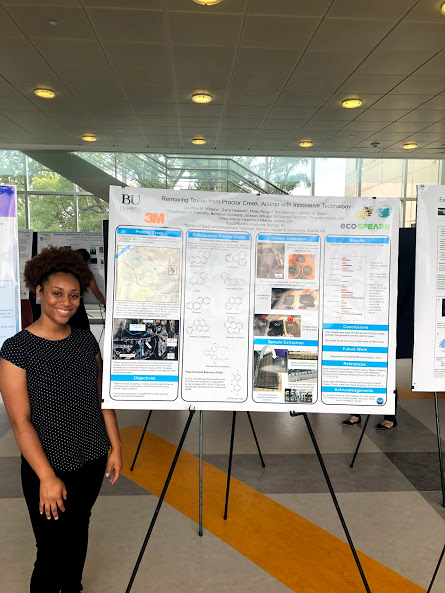
Program Dates: Summer 2027 dates will be posted around the end of the 2026 calendar year
Campus Move-In Date: TBD
REU Program Orientation: TBD
Undergraduates are invited to apply for a ten-week research program hosted by the Georgia Tech School of Earth and Atmospheric Sciences (EAS) during Summer 2027.
Working under the supervision of a faculty member or research scientist, participants will focus on a single research project but also gain a broad perspective on research in the earth and atmospheric sciences by participating in a dynamic research environment. This interdisciplinary REU program has projects spanning topics related to the geosciences, planetary science, atmospheric sciences, oceanography, and climate science. In addition to full time research, undergraduate researchers will participate in a number of professional development activities, seminars with faculty and research scientists, presentation and research poster symposiums, and social activities with other summer REU students.
Participants will receive a stipend of $7,000, travel allowances, and apartment-style housing on the Georgia Tech campus. Participants must be U.S. citizens or permanent residents of the U.S. and currently enrolled in an undergraduate degree program at a U.S. college or university (this includes remaining enrolled within an undergraduate degree program throughout the duration of the REU program). Note that students attending colleges of Universities outside of the U.S. are eligible if they are U.S. citizens or permanent residents of the U.S.
Below is the list of mentors that were available during Summer 2026 - the Summer 2027 list will be updated around the end of the 2026 calendar year.
- Dr. Jennifer Bowen (EAS, Georgia Tech)
- Dr. Winnie Chu (EAS, Georgia Tech)
- Postdoctoral research mentor: Eliza Dawson
- Grad student mentor: Ngoc Thu An (Kiera) Tran
- Dr. Armita Davarpanah (Environmental and Health Sciences, Spelman College)
- Dr. Thomas DiChristina (Biological Sciences, Georgia Tech)
- Grad student mentor: Emily Deyerle
- Dr. Lily Dove (EAS, Georgia Tech)
- Dr. Indjuaa Ganesh (EAS, Georgia Tech)
- Grad student mentor: Hephzibah Christopher
- Dr. Jennifer Glass (EAS, Georgia Tech)
- Dr. Frances Rivera-Hernández (EAS, Georgia Tech)
- Postdoctoral research mentor: Jordan Bretzfelder
- Grad student mentor: Tatiana Gibson
- Dr. Joel Kostka (Biological Sciences, Georgia Tech)
- Grad student mentor: Gabrielle Krueger
- Dr. Karl Lang (EAS, Georgia Tech)
- Postdoctoral research mentor: Abhishek Dixit
- Dr. Pengfei Liu (EAS, Georgia Tech)
- Dr. Zhigang Peng (EAS, Georgia Tech)
- Dr. Michael Peterson (GTRI SSRC)
- Dr. Alex Robel (EAS, Georgia Tech)
- Dr. Martial Taillefert (EAS, Georgia Tech)
- Dr. Yuanzhi Tang (EAS, Georgia Tech)
- Postdoctoral research mentor: Yixuan Yang
- Dr. Christy Visaggi (Geosciences, Georgia State University)
If a faculty member is not listed, the faculty member is still eligible to host an REU student. Please consider the faculty member's research program at http://www.eas.gatech.edu/research
Apply here: Link will be posted around the end of the 2026 calendar year.
Materials needed to apply:
- Transcript (unofficial is OK)
- Personal Statement - Use the personal statement to share a little about yourself and your interests. It would be helpful (but is not necessary) to address the following:
- How might this REU program be of value to you? What do you hope to gain from a summer research experience?
- Is there something in particular about the Georgia Tech EAS REU program that interests you?
- Is there anything else that you would like us to know about you?
- Two references to write letters of recommendation about you
***Application Deadline: TBD***
Questions? Contact Dr. Zachary Handlos
This material is based upon work supported by the U.S. National Science Foundation under Award No. 2349059. Any opinions, findings and conclusions or recommendations expressed in this material are those of the author(s) and do not necessarily reflect the views of the National Science Foundation.

